Kibbe, a revered dish in Middle Eastern cuisine, captivates with its exquisite blend of textures and aromatic spices. From the crispy, finely ground meat and bulgur shell to the savory, spiced filling, each bite offers a journey into culinary tradition. While preparing kibbe by hand can be a labor of love, your meat grinder, especially with a dedicated attachment, transforms this intricate process into an enjoyable and efficient endeavor. This guide will walk you through everything you need to know to create perfect kibbe, right in your own kitchen.
Understanding Kibbe: A Culinary Delight
|
Our Picks for the Best Meat grinder in 2026
As an Amazon Associate I earn from qualifying purchases.
|
||
| Num | Product | Action |
|---|---|---|
| 1 | CHEFFANO Meat Grinder, 2600W Max Stainless Steel Meat Grinder Electric, ETL Approved Heavy Duty Meat Mincer Machine with 2 Blades, 3 Plates, Sausage Stuffer Tube & Kubbe Kit for Home Kitchen Use |

|
| 2 | LEM Products BigBite #8 Meat Grinder, 0.50 HP Stainless Steel Electric Meat Grinder Machine, Ideal for Regular Use |
|
| 3 | Meat Grinder Manual Mincer 2-in-1 Manual Meat Grinder Sausage Maker Table Mount Pork Mincer Sausage Stuffer Funnel Make Homemade Burger Patties Hand Operated Kitchen Tool FQ |
|
| 4 | CHEFFANO Electric Meat Grinder, [2000W Max] Heavy Duty Meat Mincer with 2 Blades, 3 Plates, Sausage Tube & Kubbe Kit for Home Kitchen Use |
|
| 5 | Meat Chopper, Hamburger Grinder, Premium Heat Resistant Smasher for Ground Beef, Burger Grinder Nylon Potato Mix Tool, Meat & Poultry Tenderizers-Black |
|
| 6 | Electric Meat Grinder, Sausage Stuffer with 3 Sausage Tubes, 2 Blades, 3 Plates, 3200W Max, Meat Grinder Heavy Duty for Home Kitchen Use, Stainless Steel (Black) |
|
| 7 | KitchenAid Stand Mixer Attachment, Food Grinder KSMMGA, Metal Food Grinder |
|
| 8 | Meat Grinder, Sausage Stuffer, [2800W Max] Electric Meat Mincer with Stainless Steel Blades & 3 Grinding Plates,Sausage Maker & Kubbe Kit for Home Kitchen & Commercial Using |
|
| 9 | Oaomi 3200W Max Electric Meat Grinder & Sausage Stuffer - Mincer Machine with Tool 2 Blade And 3 Plates, 3 Tubes & Kubbe Kit Tool for Home Kitchen Use(Black) |
|
| 10 | GANIZA Food Processors, Electric Food Chopper with Meat Grinder & Vegetable Chopper - 2 Bowls (8 Cup+8 Cup) with Powerful 450W Copper Motor - Includes 2 Sets of Bi-Level Blades for Fruits/Meat/Nuts |
|
Kibbe, also spelled kibbeh, kubbeh, or kebbeh, is a family of dishes found across the Middle East, with Lebanon often credited for its most famous variations. Essentially, it consists of an outer shell made from finely ground meat (typically lean beef or lamb) and bulgur wheat, often stuffed with a richly spiced mixture of ground meat, onions, and pine nuts. The resulting “footballs” or patties can be fried, baked, or even served raw (kibbe nayyeh), each method offering a unique culinary experience. The challenge often lies in achieving that perfectly thin yet resilient shell and a consistent shape, which is precisely where your meat grinder attachment becomes an invaluable tool. It streamlines the most labor-intensive parts, ensuring uniformity and significantly cutting down prep time.
Essential Equipment: Your Meat Grinder and Attachments
To embark on your kibbe-making journey, the right equipment is key. A powerful meat grinder, whether electric or manual, will be your primary companion. Electric models are generally preferred for kibbe due to the need for multiple, very fine grinds, which can be tiring with a hand grinder.
Crucially, you’ll need the kibbe attachment. This specialized piece, often included with modern meat grinders or available separately, consists of a cone-shaped nozzle that attaches to the grinder’s head. As the finely ground meat and bulgur mixture is fed through, it extrudes a hollow, continuous tube, ready to be cut and stuffed. Also, ensure your grinder has a fine grinding plate, which is essential for achieving the smooth, paste-like consistency required for the kibbe shell, distinguishing it from regular ground meat. The finer the grind, the more cohesive and manageable your kibbe dough will be.
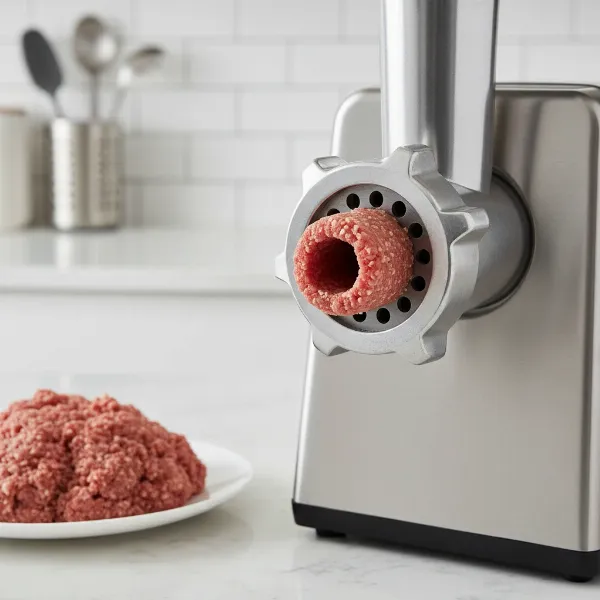 A close-up of a meat grinder with a kibbe attachment extruding a hollow tube of ground meat and bulgur mixture, illustrating the process of making kibbe shells.
Ingredients for Perfect Kibbe
Creating delicious kibbe requires fresh, quality ingredients for both the outer casing and the flavorful filling.
For the Kibbe Casing (Shell):
- Lean Meat: Approximately 1 pound (450g) of very lean beef or lamb, trimmed of all fat and sinew, cut into 1-inch cubes. The leanness is vital for the shell’s texture and ability to hold shape.
- Fine Bulgur Wheat: 1 cup (about 180g) of fine or extra-fine bulgur, rinsed thoroughly and then soaked in cold water for 20-30 minutes until softened. Squeeze out excess water well.
- Onion: 1 medium onion, roughly chopped.
- Spices: 1.5 tsp salt, 1 tsp black pepper, 1 tsp Lebanese 7-spice (baharat), 0.5 tsp ground cardamom, a pinch of freshly grated nutmeg.
For the Flavorful Filling:
- Ground Meat: 1 pound (450g) of ground beef or lamb (can be slightly fattier than the casing meat for juiciness).
- Onion: 1 large onion, finely chopped.
- Pine Nuts: 0.5 cup (about 60g) toasted pine nuts (optional, but highly recommended for texture and flavor).
- Olive Oil or Butter: 2-3 tablespoons for sautéing.
- Spices: 1 tsp salt, 0.5 tsp black pepper, 0.5 tsp Lebanese 7-spice, 1 tbsp sumac (optional, for tang).
Step-by-Step Guide: Crafting Kibbe Shells with Your Grinder
The key to excellent kibbe shells is achieving a fine, cohesive paste. Your meat grinder is indispensable here.
1. Preparation is Paramount:
Begin by rinsing your fine bulgur wheat under cold water, then soak it for about 20-30 minutes. Once softened, firmly squeeze out as much water as possible. It should be damp but not soggy. Cube your very lean beef or lamb and ensure it’s well-chilled, even partially frozen, as this aids in a cleaner grind and prevents smearing. Roughly chop the onion for the casing.
2. Grinding for the Casing: The Double Pass Technique:
Assemble your meat grinder with the fine grinding plate. First, pass the chilled meat cubes and the roughly chopped onion through the grinder. After the initial grind, combine this mixture with the soaked and drained bulgur and all the casing spices in a large bowl. Mix thoroughly by hand to distribute everything evenly.
Now, for the critical step: pass this entire mixture through the grinder a second time using the same fine plate. This double grind, or even a third pass if needed, is essential to create a smooth, sticky, dough-like consistency that is crucial for perfectly formed kibbe shells. The mixture should be pliable and cohesive, resembling a fine paste.
3. Using the Kibbe Attachment to Form Tubes:
Remove the fine grinding plate and replace it with your kibbe attachment. Ensure it’s securely fastened according to your grinder’s instructions. Feed small portions of your kibbe casing mixture into the grinder’s hopper. As the mixture is pushed through the attachment, it will emerge as a continuous, hollow tube. This is the magic of the attachment, creating the perfect base for your stuffed kibbe.
4. Forming and Shaping the Shells:
As the hollow tube emerges, gently pinch one end closed to create a sealed base. Allow a length of about 2-3 inches (5-7 cm) to extend, then use your fingers to carefully cut or pinch off the tube from the grinder. This creates your individual kibbe shell, ready for filling. Repeat the process, ensuring consistent size and shape for even cooking. For the traditional “football” shape, you can gently taper the ends after filling.
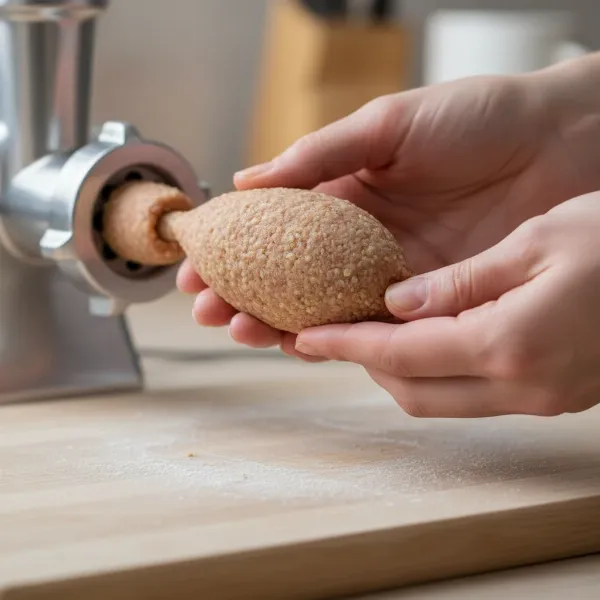 Hands demonstrating how to pinch and shape the extruded kibbe shell from a meat grinder attachment, creating the traditional 'football' shape.
Crafting the Flavorful Filling
While your shells are taking shape, prepare the rich and aromatic filling that will complete your kibbe.
1. Sautéing Aromatics and Nuts:
In a large skillet, heat olive oil or butter over medium heat. Add the finely chopped onion and sauté until it becomes soft and translucent, usually about 5-8 minutes. Add the pine nuts (if using) and toast them lightly until golden brown, which adds a delightful crunch and nutty flavor. Remove the pine nuts and set aside to prevent them from over-browning.
2. Cooking and Seasoning the Ground Meat:
Add your ground meat (beef or lamb) to the same skillet, breaking it up with a spoon. Cook over medium-high heat until it’s browned and cooked through, draining any excess fat if necessary. Season the cooked meat with salt, black pepper, Lebanese 7-spice, and sumac. Stir well to combine all the flavors. Finally, return the toasted pine nuts to the skillet and mix them into the seasoned meat filling. Allow the filling to cool slightly before assembling your kibbe. This prevents the warm filling from making the kibbe shells too soft.
“The secret to a truly great kibbe lies in the balance – a shell that’s delicately crisp and a filling that bursts with flavor. The grinder ensures consistency, but the spices bring the soul.” – Chef Amina, Middle Eastern Cuisine Specialist.
Assembling and Cooking Your Kibbe
With shells and filling ready, it’s time to bring your kibbe to life.
1. Stuffing the Shells:
Take one hollow kibbe shell in the palm of your hand. Using a small spoon or your fingers, carefully spoon the cooled meat filling into the cavity of the shell. Don’t overstuff, as this can cause the shells to burst during cooking.
2. Sealing and Shaping:
Once filled, gently pinch the open end of the kibbe shell closed, carefully sealing the filling inside. Use your hands to gently smooth and shape the kibbe into its characteristic oval or football shape, ensuring there are no cracks or openings. Place the formed kibbe on a baking sheet lined with parchment paper.
3. Cooking Methods:
- Deep-Frying (Most Traditional): Heat a generous amount of vegetable oil in a deep pot or fryer to 350-375°F (175-190°C). Fry the kibbe in batches, ensuring not to overcrowd the pot, until they are golden brown and crispy on all sides, usually 3-5 minutes per batch. Drain on paper towels.
- Baking (Healthier Alternative): Preheat your oven to 400°F (200°C). Lightly brush the formed kibbe with olive oil. Bake for 20-30 minutes, flipping halfway through, until golden brown and cooked through.
- Boiling (for Kibbe Labanieh): Some kibbe variations are boiled in a savory broth, often a yogurt-based sauce. This method results in a softer shell.
 Perfectly fried kibbe arranged on a serving plate, garnished with fresh parsley and lemon wedges.
Tips and Tricks for Kibbe Success
Mastering kibbe involves a few essential techniques that can elevate your results.
- Keep Ingredients Cold: Chilling the meat and even the grinder attachment components before grinding helps prevent the meat from heating up and smearing, ensuring a cleaner, finer grind for the casing.
- Moisten Your Hands: When handling and shaping the kibbe shells, keep your hands slightly moistened with cold water. This prevents sticking and helps create a smooth, even surface.
- Don’t Overstuff: A common mistake is overfilling the shells. This not only makes them harder to seal but also increases the likelihood of them breaking during cooking.
- Achieve the Right Consistency: The kibbe casing mixture should be like a very stiff dough. If it’s too dry, it will crack; if it’s too wet, it will be mushy and hard to handle. Adjust with a tiny bit of ice water if too dry, or a sprinkle of fine bulgur if too wet.
- Freezing for Later: Kibbe freezes exceptionally well. Arrange the formed, uncooked kibbe on a baking sheet and freeze until solid. Then transfer them to a freezer-safe bag or container. When ready to cook, you can fry or bake them directly from frozen, adding a few extra minutes to the cooking time.
Troubleshooting Common Kibbe Grinding Issues
Even experienced cooks can encounter hiccups. Here are some common issues and their solutions:
- Mixture Too Wet/Mushy: This often happens if the bulgur wasn’t squeezed enough or the meat had too much moisture. Add a small amount of fine bulgur or even a tablespoon of all-purpose flour to help absorb excess moisture and firm up the mixture.
- Attachment Clogging: If the grinder is struggling or the kibbe tube isn’t forming cleanly, the mixture might be too dry or not ground finely enough. Ensure the mixture has a paste-like consistency and try adding a teaspoon of cold water to small portions if needed. Also, make sure all grinder parts are clean and properly assembled.
- Shells Breaking During Forming or Frying: This can be due to an inconsistent grind, a mixture that’s too dry, or overstuffing. Re-grinding the casing mixture can help ensure a finer, more cohesive dough. If the mixture is too dry, knead in a tiny bit of cold water. Ensure shells are properly sealed before frying.
Conclusion
Creating authentic kibbe with a meat grinder attachment is a rewarding culinary adventure that brings the flavors of the Middle East into your home. This powerful kitchen tool simplifies the intricate process, allowing you to achieve perfectly formed, delicious kibbe with greater ease and consistency. By understanding the key steps—from preparing your ingredients and achieving the ideal casing texture to expertly stuffing and cooking—you’re well on your way to mastering this beloved dish. Embrace the process, experiment with spices, and savor the rich heritage in every bite. What family recipe will you adapt to your meat grinder next?
Frequently Asked Questions
What kind of meat is best for kibbe?
For the kibbe casing, very lean meat like top round beef or lean lamb is ideal. Excess fat can make the shell too greasy and prone to falling apart. For the filling, a slightly fattier ground beef or lamb can be used to ensure a juicy and flavorful interior.
Can I use a food processor instead of a meat grinder?
While some recipes suggest a food processor for kibbe, a meat grinder with its dedicated kibbe attachment is superior for achieving the very fine, paste-like consistency required for the shell and for effortlessly forming the hollow tubes. A food processor might produce a coarser texture.
How fine should the bulgur be for kibbe?
You should use fine or extra-fine bulgur wheat for kibbe. This type of bulgur softens quickly and integrates seamlessly with the ground meat to create the smooth, dough-like texture necessary for the kibbe casing. Coarse bulgur will result in a grainy texture.
What is Lebanese 7-spice (baharat)?
Lebanese 7-spice, or baharat, is a quintessential Middle Eastern spice blend that typically includes black pepper, cumin, coriander, cloves, nutmeg, cinnamon, and cardamom. It provides the characteristic warm and aromatic flavor profile to both the kibbe casing and filling.
Can I freeze uncooked kibbe?
Yes, uncooked kibbe freezes exceptionally well. After forming and stuffing the kibbe, arrange them in a single layer on a baking sheet and freeze until solid. Once frozen, transfer them to an airtight freezer bag or container. They can be cooked directly from frozen, adding a few extra minutes to the frying or baking time.