For any successful deli, the quality and consistency of freshly ground meat are paramount. It’s what transforms good ingredients into exceptional burgers, sausages, and specialty deli items that keep customers coming back. But achieving this consistent excellence, especially when handling high volumes, requires more than just a standard kitchen appliance. It demands a robust, heavy-duty meat grinder designed for the rigors of commercial use.
Choosing the right heavy-duty meat grinder is a strategic investment that impacts everything from product quality and operational efficiency to food safety and profitability. With a myriad of options available, understanding what truly constitutes a commercial-grade grinder and which features matter most for a bustling deli can be overwhelming. This comprehensive guide is designed to help you navigate the landscape of heavy-duty meat grinders, ensuring you select the perfect workhorse for your deli’s unique needs.
Understanding Heavy-Duty Meat Grinders for Deli Shops
A heavy-duty meat grinder isn’t merely a larger version of a home appliance; it’s a precisely engineered machine built for endurance and performance in demanding professional environments. Delis, butcher shops, and restaurants rely on these units for their ability to process substantial quantities of meat consistently and safely.
What Defines “Heavy-Duty” for Commercial Use?
The distinguishing characteristics of a heavy-duty commercial meat grinder include:
- Motor Power: These machines feature high-performance motors, typically ranging from 0.5 horsepower (HP) to upwards of 5 HP, designed for continuous operation without overheating or straining.
- Robust Construction: Commercial grinders are built with professional-grade materials, predominantly stainless steel for parts that contact meat, ensuring superior durability, corrosion resistance, and ease of sanitation. Some models may feature heavy-duty cast aluminum for the body, offering a robust and easy-to-clean base.
- High Processing Capacity: They are engineered for large-volume processing, capable of grinding many pounds of meat per minute or hour, essential for meeting peak demand in a busy deli.
- Exceptional Durability: Built for daily, intensive use, these machines withstand the constant wear and tear of a commercial kitchen.
- Precise Grinding Consistency: Commercial units deliver precise, uniform results every time, crucial for product quality and customer satisfaction.
|
Our Picks for the Best Meat grinder in 2026
As an Amazon Associate I earn from qualifying purchases.
|
||
| Num | Product | Action |
|---|---|---|
| 1 | Oaomi 3200W Max Electric Meat Grinder & Sausage Stuffer - Mincer Machine with Tool 2 Blade And 3 Plates, 3 Tubes & Kubbe Kit Tool for Home Kitchen Use(Black) |

|
| 2 | KitchenAid Stand Mixer Attachment, Food Grinder KSMMGA, Metal Food Grinder |
|
| 3 | Meat Chopper, Hamburger Grinder, Premium Heat Resistant Smasher for Ground Beef, Burger Grinder Nylon Potato Mix Tool, Meat & Poultry Tenderizers-Black |
|
| 4 | LEM Products BigBite #8 Meat Grinder, 0.50 HP Stainless Steel Electric Meat Grinder Machine, Ideal for Regular Use |
|
| 5 | Meat Grinder, Sausage Stuffer, [2800W Max] Electric Meat Mincer with Stainless Steel Blades & 3 Grinding Plates,Sausage Maker & Kubbe Kit for Home Kitchen & Commercial Using |
|
| 6 | GANIZA Food Processors, Electric Food Chopper with Meat Grinder & Vegetable Chopper - 2 Bowls (8 Cup+8 Cup) with Powerful 450W Copper Motor - Includes 2 Sets of Bi-Level Blades for Fruits/Meat/Nuts |
|
| 7 | CHEFFANO Meat Grinder, 2600W Max Stainless Steel Meat Grinder Electric, ETL Approved Heavy Duty Meat Mincer Machine with 2 Blades, 3 Plates, Sausage Stuffer Tube & Kubbe Kit for Home Kitchen Use |
|
| 8 | CHEFFANO Electric Meat Grinder, [2000W Max] Heavy Duty Meat Mincer with 2 Blades, 3 Plates, Sausage Tube & Kubbe Kit for Home Kitchen Use |
|
| 9 | Electric Meat Grinder, Sausage Stuffer with 3 Sausage Tubes, 2 Blades, 3 Plates, 3200W Max, Meat Grinder Heavy Duty for Home Kitchen Use, Stainless Steel (Black) |
|
| 10 | Meat Grinder Manual Mincer 2-in-1 Manual Meat Grinder Sausage Maker Table Mount Pork Mincer Sausage Stuffer Funnel Make Homemade Burger Patties Hand Operated Kitchen Tool FQ |
|
Why Delis Need Commercial-Grade Grinders
Investing in a commercial meat grinder offers significant benefits that directly impact your deli’s success:
- Superior Quality Control: In-house grinding provides complete control over the meat’s freshness, fat ratio, and texture, allowing for custom blends and premium products.
- Enhanced Food Safety Standards: Stainless steel construction and designs that facilitate easy cleaning and sanitization are vital for adhering to strict hygiene protocols and regulatory compliance, minimizing the risk of cross-contamination.
- Significant Operational Efficiency: High-capacity processing capabilities mean you can handle substantial volumes quickly, streamlining your preparation workflow and reducing labor costs.
- Reliable Performance Consistency: Professional-grade construction ensures dependable operation during your busiest periods, preventing costly downtime.
- Cost-Effectiveness: Grinding whole muscle cuts in-house is often more economical than purchasing pre-ground meat, leading to better profit margins.
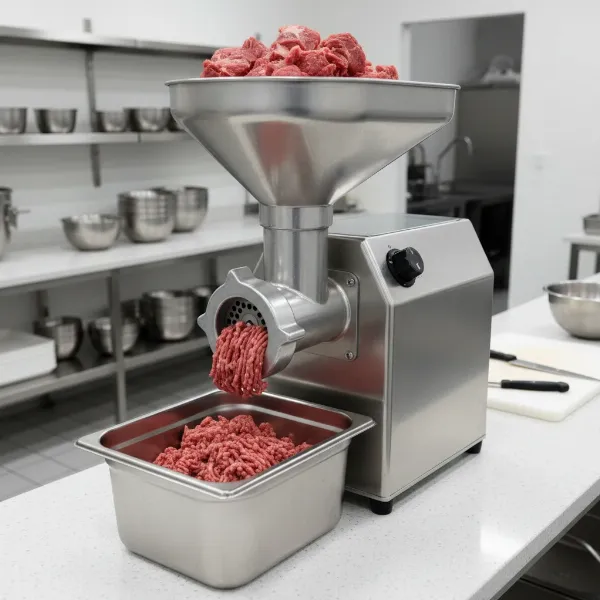 A robust commercial meat grinder, made of stainless steel, actively grinding meat in a clean deli environment.
Types of Commercial Meat Grinders
When selecting a heavy-duty meat grinder, understanding the different configurations available is key to matching the machine to your operational flow and available space.
Electric vs. Manual Grinders
For almost all commercial deli operations, electric meat grinders are the only practical choice. These powerful machines efficiently handle large quantities of meat with the simple flip of a switch. While manual grinders, operated by a hand crank, are suitable for occasional home use or very small-scale artisanal tasks, they simply cannot keep pace with the demands of a professional kitchen.
Countertop vs. Floor Models
The physical footprint and capacity are critical considerations that determine whether you need a countertop or a floor model.
- Countertop Grinders: These compact units are designed to sit on a sturdy work surface. They are an excellent choice for delis or small cafes with moderate grinding needs and limited space. Many offer substantial power and capacity within a smaller footprint.
- Floor Models: Larger, freestanding units, floor models are built for heavy-duty, high-volume work. You’ll typically find these in large butcher shops, meat processing facilities, or very high-volume delis where grinding is a continuous and core task. They offer greater power and capacity but require dedicated floor space.
Key Features to Look for in a Deli Meat Grinder
Navigating the technical specifications of commercial meat grinders can be daunting. Focusing on these essential features will help you identify a machine that not only performs well but also integrates seamlessly into your deli’s operations.
Motor Power (Horsepower & Watts)
The motor is the heart of your meat grinder, dictating its processing speed and endurance. Commercial models range from 0.5 HP to 5 HP or more.
- 0.5 to 1 HP: Typically sufficient for smaller delis or cafes with moderate grinding needs, such as making fresh burgers or breakfast sausages. An example like the Express KitchQuip Commercial Deli Meat Grinder features a 1 HP motor (750W), offering ample power for efficient processing.
- 1.5 HP and above: Recommended for delis with high demand for ground meat, or those regularly processing tougher cuts.
- 2 HP to 5 HP+: Ideal for very high-volume kitchens or butcher shops that grind meat for hours daily, handling hundreds of pounds per hour, potentially even frozen blocks.
Processing Capacity
Consider how much meat your deli needs to process during its busiest times. Commercial electric grinders can handle anywhere from a few pounds to over 65 pounds of meat per minute. Choose a model that can comfortably exceed your peak requirements to ensure smooth operations and extend the machine’s lifespan.
Construction Materials
Durability and hygiene are paramount in a commercial setting.
- Stainless Steel: Look for models with a full stainless steel finish, especially for all parts that come into contact with meat (grinding head, auger, blade, plates, and hopper). Stainless steel is incredibly durable, resistant to corrosion, non-porous, and easy to sanitize, making it the industry standard for food safety.
- Cast Aluminum: While stainless steel is preferred, some sturdy commercial grinders feature a cast aluminum body, which is durable and easy to clean, often contributing to a more compact design.
Grinding Plates and Cutting System
The grinding plates are crucial for controlling the final texture of your meat.
- Multiple Plate Sizes: Most quality commercial grinders come with a selection of metal plates, ranging from fine (e.g., 1mm) to coarse (e.g., 13mm) holes. This versatility allows you to create various textures for different products, from finely ground pâtés to chunkier chili meat or sausage.
- Clean Cutting: Ensure the system cuts meat cleanly rather than smearing it, which can happen with underpowered motors or dull blades, resulting in poor texture.
Safety Features
Safety is non-negotiable in any professional kitchen. Essential safety features include:
- Feed Stomper: Keeps hands away from the grinding mechanism.
- Overload Protection: Prevents the motor from burning out during heavy use.
- Reverse Function: Allows you to easily clear jams without disassembling the machine.
- Safety Guards and Certifications: Look for commercial certifications to ensure compliance with food safety regulations.
Ease of Cleaning and Maintenance
A grinder that is easy to clean will be used more often and maintained properly.
- Easy Disassembly: The machine should be simple to take apart without special tools for thorough daily cleaning.
- Non-Porous Surfaces: Materials that prevent bacterial growth and are easy to wipe down.
Footprint and Portability
Consider your available kitchen space. Countertop models save floor space, while floor models require a dedicated area. If flexibility is needed, a lighter countertop unit might be preferred.
Top Heavy-Duty Meat Grinder Brands & Models for Deli Shops
Several brands consistently deliver high-quality, reliable heavy-duty meat grinders for commercial use.
- Hobart: Widely considered the industry standard, Hobart commercial meat grinders are renowned workhorses built for exceptional durability and consistent performance in the most demanding environments. An investment in Hobart is often seen as an investment in reliability where downtime is not an option.
- Pro-Cut & Talsa: For deli operations requiring serious power and high-volume processing, including tough cuts or even frozen meat blocks, brands like Pro-Cut and Talsa offer robust machines designed for maximum efficiency and raw processing strength. For instance, the Pro-Cut KG-32-XP boasts 5 HP and an impressive throughput.
- Weston: While Weston offers models for home users, their Pro Series (e.g., #12 or #22) are recognized for commercial use, providing strong performance and durability for high-volume meat processing. The Weston 33-1301-W Pro Series #12 Electric Meat Grinder is noted for its forward and reverse operation and smooth grinding.
- Avantco: For delis operating on a tighter budget, Avantco Equipment offers a compelling combination of performance and value, providing reliable functionality for moderate daily operations without the premium price tag. The Avantco MG22R #22 is a good budget-friendly option.
- Express KitchQuip Commercial Deli Meat Grinder – #12 Hub: This specific model, with its 1 HP motor and cast aluminum construction, is highlighted as a space-efficient and powerful choice perfect for delicatessens, grocery stores, and restaurants seeking a durable and easy-to-clean solution.
Maximizing Your Investment: Usage and Maintenance Tips
To ensure your heavy-duty meat grinder operates efficiently, remains safe, and lasts for years, proper usage and diligent maintenance are essential.
Smart Operation
- Chill Your Meat: Always ensure meat is well-chilled, ideally partially frozen, before grinding. This prevents smearing and ensures a clean cut, preserving meat texture and quality.
- Steady Feed: Feed meat steadily into the hopper without forcing it. Consistent pressure helps maintain optimal motor performance and uniform grinding. Always use the provided food stomper, never your hands.
- Monitor Quality: Continuously observe the consistency of the ground meat and adjust your feeding rate as needed.
Diligent Daily Cleaning and Sanitizing
This is a non-negotiable step after every use:
- Unplug and Disassemble: Always unplug the machine before disassembling all removable parts: the tray, stomper, grinding head, auger (worm), blade, and grinding plate.
- Scrape and Wash: Scrape off any large pieces of meat or fat. Wash all components thoroughly in a three-compartment sink with hot, soapy water. Use a stiff brush to meticulously scrub away residue, paying extra attention to the blade and the plate’s holes where bacteria can hide.
- Rinse and Sanitize: Rinse all parts with clean water, then sanitize them according to local health code requirements before allowing them to air dry completely.
 Close-up of disassembled commercial meat grinder parts, including the auger and blade, being meticulously cleaned.
Essential Maintenance
- Blade and Plate Care: Keep your blades and plates sharp. Dull blades force the motor to work harder and produce a poor-quality grind. Consider professional sharpening or replacing these components when you notice a dip in performance.
- Motor Lubrication: While the motor housing should only be wiped down, apply a light coating of food-grade mineral oil or silicone spray to the auger, blade, and plates after they are completely dry. This prevents rust and ensures smooth operation. Always consult your manufacturer’s manual for specific lubrication guidelines.
- Regular Inspections: Periodically inspect your grinder for signs of wear and tear on components like the power cord, blades, or plates. Addressing small issues early can prevent more significant, costly problems down the line.
Proper Storage
Moisture is the enemy of metal. Ensure every part is completely dry before storing the grinder in a clean, dry area away from humidity. Storing it disassembled, with all small parts together in a designated container, helps prevent loss and allows for better air circulation.
Conclusion
A heavy-duty meat grinder is more than just a kitchen appliance for a deli; it’s a cornerstone of quality, efficiency, and food safety. By understanding the distinct advantages of commercial-grade machines, recognizing key features like motor power, robust construction, and essential safety measures, and committing to a rigorous maintenance routine, you empower your deli to consistently deliver superior products. Brands like Hobart, Pro-Cut, Weston, and Avantco offer reliable options to suit various operational scales and budgets.
Investing in the right heavy-duty meat grinder ensures your deli thrives, transforming raw ingredients into culinary masterpieces that delight your customers every time. Are you ready to elevate your deli’s meat processing capabilities and unlock new levels of quality and efficiency?