In a world brimming with electrical appliances, from the smallest smartphone charger to powerful kitchen gadgets and industrial machinery, wattage is a term you encounter constantly. It’s often associated with power and capability, leading to a common assumption: “higher wattage means better performance.” But is this always the case? The answer, like electricity itself, is a bit more complex than a simple yes or no. Understanding wattage is crucial not just for getting the best out of your devices, but also for managing energy consumption and ensuring safety in your home or workplace. Let’s demystify wattage and explore what it truly means for the performance and efficiency of your electrical equipment.
Understanding Wattage: The Foundation of Power
At its core, wattage (symbolized as ‘W’) is a fundamental measure of electrical power. Think of it as the rate at which electrical energy is consumed or produced by a device at any given moment. It quantifies how much “work” electricity is doing per second.
The relationship between wattage and other electrical units is straightforward: Watts are calculated by multiplying volts (V), which represent electrical pressure or potential difference, by amps (A), which measure the electric current or the flow of charges through a wire. So, the formula is Watts = Volts × Amps. To illustrate, imagine electricity flowing through a system like water in a hose: voltage is the water pressure, amperage is the thickness of the hose (volume of water), and wattage is the total force or power of the water leaving the hose.
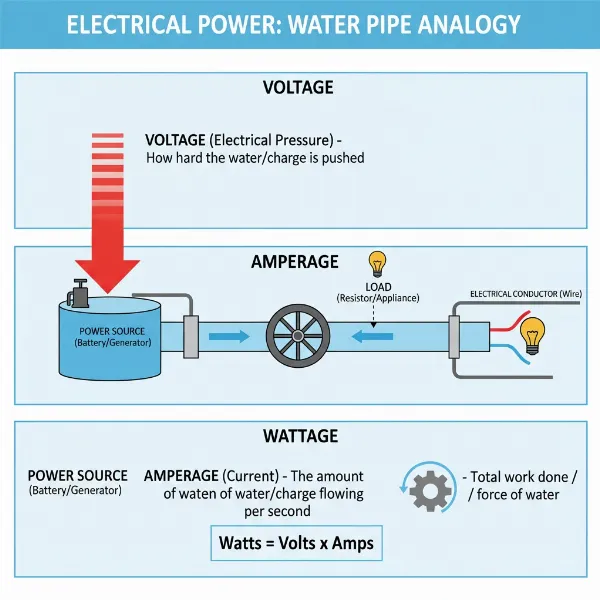 Diagram illustrating the relationship between voltage, current (amperage), and wattage in an electrical circuit.
It’s important to distinguish between watts and watt-hours (Wh) or kilowatt-hours (kWh). While watts measure instantaneous power, watt-hours represent the total amount of energy consumed over a period, typically one hour. Your electricity bill, for instance, is calculated based on kilowatt-hours, reflecting how much energy your appliances have used over time, not just their peak power draw. A 1000W appliance, for example, running for one hour consumes 1000 watt-hours of energy.
Debunking the Myth: Higher Wattage Doesn’t Always Mean “Better”
The intuitive link between higher wattage and superior performance often stems from observing powerful appliances. We naturally assume more power consumption translates directly to more effective output. However, this is a misconception that doesn’t hold true across all types of devices.
The critical factor often overlooked is efficiency. An appliance’s efficiency dictates how much of the consumed electrical power is converted into useful work versus wasted as heat or other non-productive forms. A less efficient device, even with high wattage, might waste a significant portion of that energy, leading to higher electricity bills without a proportional increase in performance. In industrial automation, for instance, a high-wattage motor might have a greater capacity, but if the system is inefficient, much of that energy simply dissipates as heat, rather than performing useful output.
Wattage in Action: Appliance Categories and Their Needs
The significance of wattage varies greatly depending on the type of appliance and its primary function.
Heating Appliances
|
Our Picks for the Best Meat grinder in 2026
As an Amazon Associate I earn from qualifying purchases.
|
||
| Num | Product | Action |
|---|---|---|
| 1 | GANIZA Food Processors, Electric Food Chopper with Meat Grinder & Vegetable Chopper - 2 Bowls (8 Cup+8 Cup) with Powerful 450W Copper Motor - Includes 2 Sets of Bi-Level Blades for Fruits/Meat/Nuts |

|
| 2 | LEM Products BigBite #8 Meat Grinder, 0.50 HP Stainless Steel Electric Meat Grinder Machine, Ideal for Regular Use |
|
| 3 | Electric Meat Grinder, Sausage Stuffer with 3 Sausage Tubes, 2 Blades, 3 Plates, 3200W Max, Meat Grinder Heavy Duty for Home Kitchen Use, Stainless Steel (Black) |
|
| 4 | Meat Chopper, Hamburger Grinder, Premium Heat Resistant Smasher for Ground Beef, Burger Grinder Nylon Potato Mix Tool, Meat & Poultry Tenderizers-Black |
|
| 5 | Meat Grinder, Sausage Stuffer, [2800W Max] Electric Meat Mincer with Stainless Steel Blades & 3 Grinding Plates,Sausage Maker & Kubbe Kit for Home Kitchen & Commercial Using |
|
| 6 | CHEFFANO Meat Grinder, 2600W Max Stainless Steel Meat Grinder Electric, ETL Approved Heavy Duty Meat Mincer Machine with 2 Blades, 3 Plates, Sausage Stuffer Tube & Kubbe Kit for Home Kitchen Use |
|
| 7 | Meat Grinder Manual Mincer 2-in-1 Manual Meat Grinder Sausage Maker Table Mount Pork Mincer Sausage Stuffer Funnel Make Homemade Burger Patties Hand Operated Kitchen Tool FQ |
|
| 8 | CHEFFANO Electric Meat Grinder, [2000W Max] Heavy Duty Meat Mincer with 2 Blades, 3 Plates, Sausage Tube & Kubbe Kit for Home Kitchen Use |
|
| 9 | Oaomi 3200W Max Electric Meat Grinder & Sausage Stuffer - Mincer Machine with Tool 2 Blade And 3 Plates, 3 Tubes & Kubbe Kit Tool for Home Kitchen Use(Black) |
|
| 10 | KitchenAid Stand Mixer Attachment, Food Grinder KSMMGA, Metal Food Grinder |
|
For devices designed to generate heat, such as electric kettles, toasters, space heaters, and hair dryers, higher wattage generally translates directly to faster heating or more intense heat output. A 1500-watt space heater will warm a room quicker than a 750-watt model, and a high-wattage kettle will boil water more rapidly. This is because their primary function involves converting electrical energy into thermal energy, and a higher rate of energy consumption directly supports this goal.
Motorized Appliances
Appliances with electric motors, like blenders, vacuum cleaners, food processors, and power tools, also often benefit from higher wattage. In these cases, greater wattage typically means more torque, higher speed, and the ability to handle tougher tasks without straining or overheating. A high-wattage blender can crush ice more easily, and a powerful drill can bore through dense materials with less effort. For power tools specifically, “higher wattage will mean more power for your task”.
Lighting
This is where the “higher wattage equals better” myth most notably falters. For light bulbs, wattage indicates energy consumption, not brightness. Brightness is actually measured in lumens. Modern LED (Light Emitting Diode) technology has revolutionized lighting, allowing bulbs to produce the same amount of light (lumens) as older incandescent bulbs while consuming significantly fewer watts. For example, a 10-watt LED bulb can provide the same brightness as a 60-watt incandescent bulb, dramatically reducing energy use without sacrificing illumination.
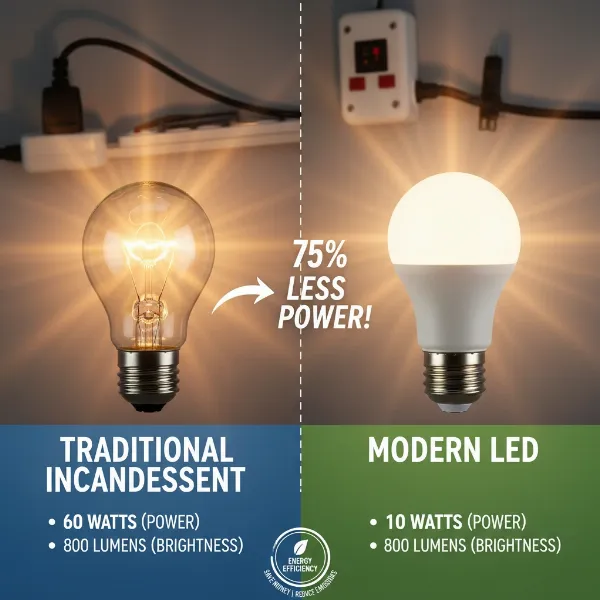 Comparison of an old incandescent light bulb and a modern LED bulb, highlighting that LEDs provide more lumens with less wattage.
Electronics & Computer Components
In the realm of electronics, such as phone chargers, laptops, and especially computer Power Supply Units (PSUs), wattage often refers to the maximum capacity or potential power output, rather than a constant draw. For PSUs, a higher wattage rating means the unit can supply more power if needed by the computer’s components. A system will only draw the amount of power it requires, regardless of the PSU’s maximum wattage. Therefore, choosing a higher-wattage PSU than your system’s exact needs can offer several advantages:
- Future-Proofing: It provides headroom for future upgrades, like a more powerful graphics card or processor.
- Stability: A PSU operating at a lower percentage of its total capacity (often 40-60%) can run more efficiently and stably, especially during demanding tasks.
- Longevity: Running a PSU below its maximum load can contribute to a longer lifespan.
In this context, “better” doesn’t mean constantly consuming more power, but rather having a robust capacity that leads to greater reliability and upgrade flexibility.
The Nuance of “Better”: When Higher Wattage is Beneficial, and When It’s Not
The true meaning of “better” concerning wattage is contextual.
When Higher Wattage is Beneficial:
- Speed and Force: For tasks requiring rapid heating or significant mechanical force, higher wattage often delivers tangible benefits in performance.
- Demanding Tasks: Power tools, heavy-duty blenders, or industrial machinery tackling challenging materials genuinely need higher wattage for effective operation.
- Capacity and Stability: For power supplies in systems like computers, a higher wattage capacity ensures stability, accommodates peak demands, and allows for future expansion.
When Higher Wattage is Not Necessarily Better (or even detrimental):
- Unnecessary Energy Consumption: If a device’s high wattage isn’t efficiently converted into useful output, or if you simply don’t need that level of power for your tasks, it translates to wasted energy and higher electricity bills.
- Circuit Overload Risk: High-wattage appliances, especially when multiple are used on the same circuit, can draw too much current, leading to tripped breakers or, in severe cases, melted wires and fire hazards. Always check your home’s circuit capacity before plugging in new, high-wattage devices.
- Misleading Metrics: For products like light bulbs, focusing solely on wattage will lead you away from more efficient choices. Lumens are the performance metric that matters for brightness.
Making Informed Choices: How to Interpret Wattage Ratings
To make the best decisions, look beyond just the wattage number:
- Identify the Appliance Type: Understand what wattage signifies for that specific category. Is it about heat output, motor strength, or power capacity?
- Consider Your Needs: Do you genuinely need maximum power, or will a lower-wattage, more efficient model suffice for your typical usage?
- Check for Efficiency Ratings: Look for certifications like Energy Star, which indicate appliances that deliver performance using less energy.
- Evaluate Other Performance Metrics: For lighting, prioritize lumens. For blenders, look at RPM or blade design. For electronics, consider features and overall build quality alongside wattage.
- Assess Circuit Compatibility: Be mindful of the wattage drawn by your appliances and ensure your electrical circuits can safely handle the load.
Safety and Efficiency: Managing Your Wattage Wisely
Understanding wattage isn’t just about buying the right appliance; it’s also about using them safely and efficiently.
- Preventing Overloads: Avoid plugging multiple high-wattage devices into a single outlet or circuit simultaneously. Distribute them across different circuits or use power strips with surge protection for sensitive electronics. If you’re planning a major appliance addition or remodel, consult a licensed electrician to ensure your home’s wiring can handle the load.
- Saving on Bills: Opting for lower-wattage, energy-efficient alternatives where performance isn’t compromised can significantly reduce your electricity consumption and, consequently, your monthly bills. Smart plugs can help monitor individual device usage, revealing hidden energy drains.
- Smart Usage Practices: Unplug chargers and devices when not in use, as many still draw “phantom” power even when turned off. Utilize energy-saving modes on appliances whenever possible.
“Wattage is a powerful indicator, but it’s only one piece of the puzzle. The real ‘power’ lies in understanding how efficiently that wattage is being used to meet your specific needs.” – Dr. Elena Petrova, Electrical Engineering Professor
Conclusion
Wattage is undeniably a crucial specification for any electrical appliance, reflecting its power consumption rate. However, the notion that higher wattage universally equates to better performance is a nuanced one. While it certainly holds true for tasks requiring brute force or intense heat, it becomes less relevant or even misleading for categories like lighting, where efficiency and specific performance metrics like lumens take precedence. For electronics, higher wattage often signals greater capacity and stability rather than increased energy draw during normal operation.
By understanding these distinctions, you empower yourself to make smarter purchasing decisions, optimize energy use, and maintain electrical safety. Don’t simply chase the highest number; instead, evaluate wattage in the context of the appliance’s function, its efficiency, and your actual requirements. What role does a balanced understanding of wattage play in your daily energy-saving habits?